11 Innovative DeFi Projects to Watch in 2026
9 mins

DeFi in 2026 doesn’t look like it did two years ago. The protocols gaining real traction aren’t rehashing the same lending-and-swapping playbook, they’re building entirely new financial primitives. Unified margin accounts, privacy-first stablecoin chains, funding rate derivatives, equity perps running 24/7 from a wallet.
We’ve been tracking this shift closely, and what stands out is how interconnected the new wave is. The most innovative DeFi projects in 2026 aren’t isolated products; they’re interoperable multi-chain and integrated with major DeFi markets, creating yield loops and liquidity networks that didn’t exist 12 months ago.
Here are 11 protocols building the next financial layer.
Top 11 innovative DeFi projects to use and earn in 2026
- Paradex: The Zero-Fee ZK Perps Exchange
- Variational: P2P Derivatives With Zero-Fee Retail Trading
- World Markets: The Everything Account on MegaETH
- Ethereal: The USDe-Native Everything App
- Boros: Pendle’s Expansion Into Funding Rate Derivatives
- Ostium: RWA Perps That Actually Found Product-Market Fit
- trade.xyz: 24/7 Stock and Commodity Perps on Hyperliquid
- Morpho: The Modular Lending Layer for Institutional DeFi
- RAILGUN: Private DeFi That Actually Works
- Payy: The Privacy-First Crypto Card and Stablecoin Chain
- ether.fi: The DeFi Neobank With 70,000 Active Cards
1. Paradex: The Zero-Fee ZK Perps Exchange
- Category: Perp DEX
- Chain: appchain on Starknet
- TVL: $159 billion
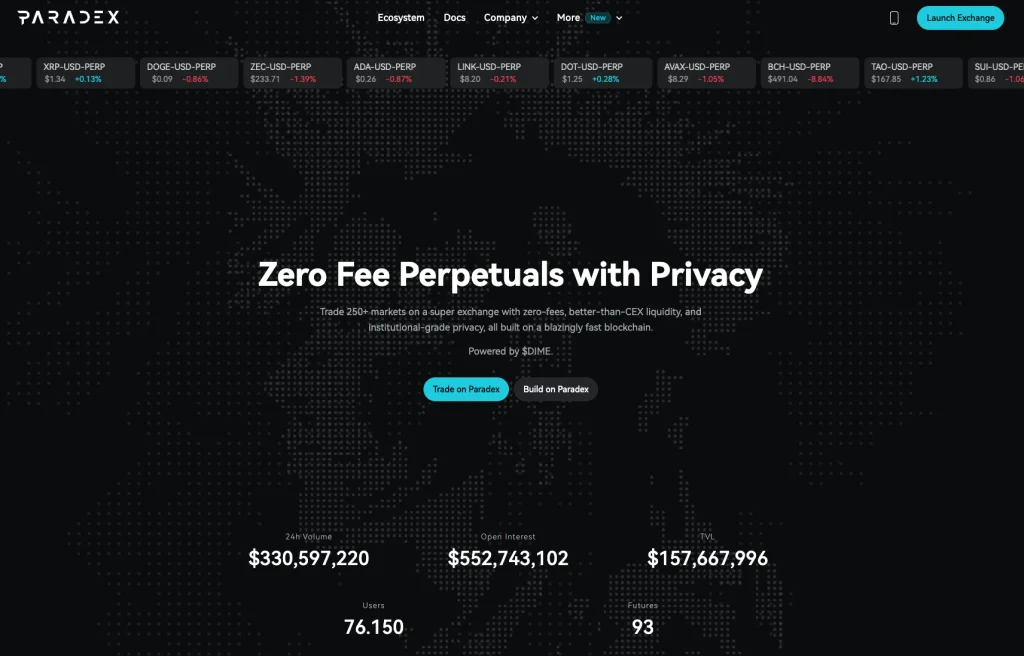
Paradex is the most architecturally interesting challenger in the perp DEX space right now. Built as a high-performance appchain on Starknet and incubated by Paradigm, it combines zero-fee trading for retail with ZK-encrypted accounts that hide positions, entries, exits, and liquidation levels.
Its performance is impressive: $244 billion cumulative volume, $553 million in open interest, $158 million TVL. Instead of maker-taker fees, Paradex uses Retail Price Improvement, 0.5 bps on retail fills from professional market makers. Payment-for-order-flow is done onchain with open competition.
From what we’ve observed, Paradex feels less like a pure perps DEX and more like a diversified financial venue. The roadmap spans spot, perpetual options, and a synthetic dollar (XUSD). Whether zero-fee sustains post-TGE is the critical question, but execution quality and ZK privacy are genuinely differentiated.
2. Variational: P2P Derivatives With Zero-Fee Retail Trading
- Category: Perp DEX
- Chain: Arbitrum
- Trading volume: $70.6 billion
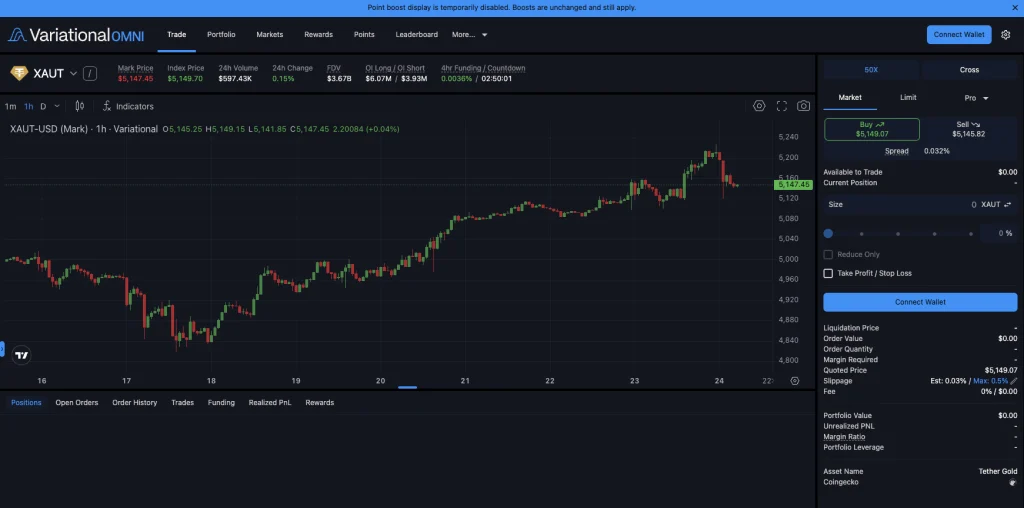
Variational takes a fundamentally different approach to onchain derivatives. Instead of an orderbook or AMM, it automates bilateral P2P clearing for perps, futures, and options on Arbitrum. Its retail app Omni runs with zero trading and gas fees, while the Omni Liquidity Provider aggregates liquidity across CEXs and onchain venues into a single counterparty.
The protocol crossed $70.6 billion in lifetime trading volume and $750 million in open interest, powered largely by zero-fee trading and a well-designed points program. We’ve seen this pattern before: incentive-driven volume can be hollow. But Variational’s architecture, direct bilateral settlement rather than pooled risk, creates structural advantages for exotic derivatives that orderbook DEXs can’t easily replicate.
Founded by former Genesis Trading executives, the team understands institutional market-making from the inside. The question is that can they retain volume after the incentives fade?
3. World Markets: The Everything Account on MegaETH
- Category: Liquidity layer
- Chain: MegaETH
- TVL: $8.3 million
World Markets launched on February 17, 2026, as one of the first dApps on MegaETH, and it’s attempting something no other DEX has done: unifying spot, perpetual futures, and undercollateralized lending into a single cross-margin account.
The innovation is the ATLAS risk engine. It performs portfolio-level netting, recognizing that a hedged position (like a basis trade) carries zero directional risk, and unlocks dramatically higher leverage accordingly. No auto-deleveraging. No unfair liquidations of profitable hedged positions. Capital efficiency up to 100x greater than current DEXs, according to the team.
It’s early, World Markets has ~$8.3 million in TVL and no VC funding, but MegaETH’s 50,000 TPS and 10ms block times give it infrastructure that didn’t exist six months ago. The co-founder put it simply: there hasn’t been a successful DEX on a general-purpose chain because gas and speed made it impossible for market makers to quote tight spreads. MegaETH changes that equation. Vaults for automated leveraged basis trades are coming in one to two months.
4. Ethereal: The USDe-Native Everything App
- Category: DEX
- Chain: Ethereum
- TVL: $3 billion
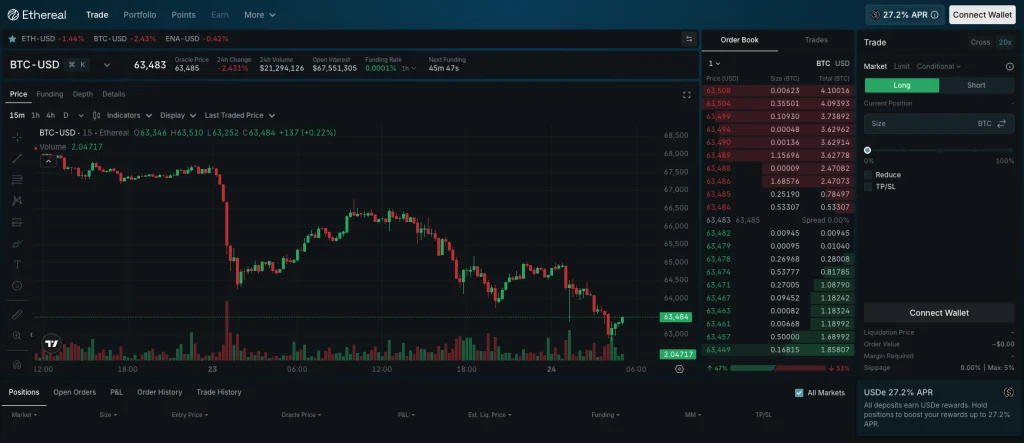
Ethereal is a non-custodial DEX built as a Layer-3 appchain within the Ethena ecosystem, using USDe as the primary margin collateral. That means your collateral earns yield while you trade — a structural advantage over USDC-margined venues.
Mainnet Alpha went live in October 2025, with cumulative volume reaching $5 billion, $126 million in open interest, and $65 million in TVL per DefiLlama. The architecture is purpose-built: execution via custom sequencer with sub-20ms latency, settlement on Arbitrum One, data availability on Celestia.
What makes Ethereal worth watching isn’t just the perps, it’s the roadmap to become a “DeFi everything app” around USDe. Spot markets, money markets, and RWA integrations are all planned. ENA stakers receive Ethereal points, tying ecosystem incentives together. If USDe continues growing as DeFi’s dominant yield-bearing collateral, Ethereal becomes its native trading venue.
5. Boros: Pendle’s Expansion Into Funding Rate Derivatives
- Category: Rate trading
- Chain: Ethereum, Arbitrum, Solana, HyperEVM
- TVL: $7.5 billion
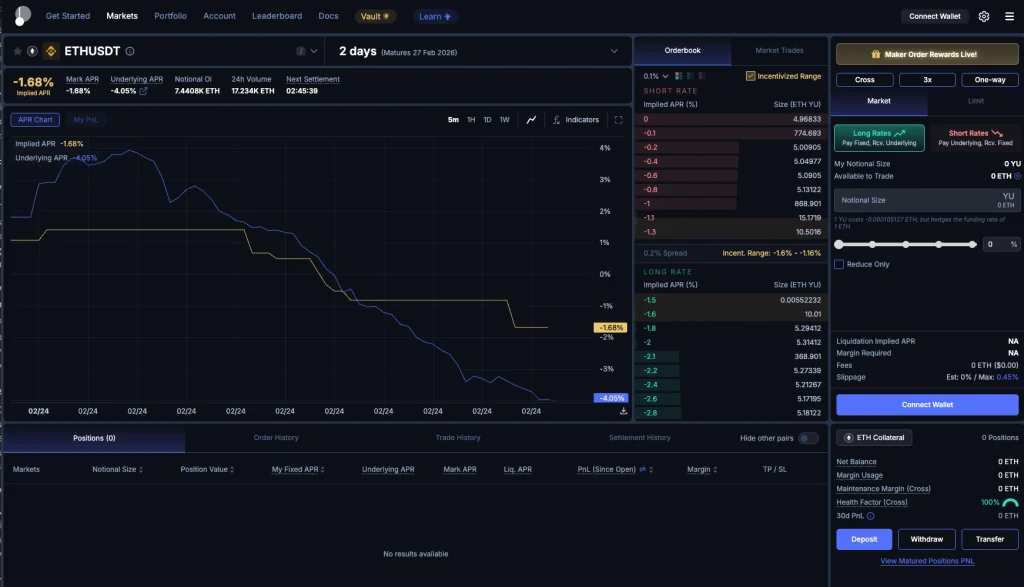
Boros, built by the Pendle team, tokenizes perpetual futures funding rates — a $150 billion+ daily OI market that had no liquid onchain tool. This is genuinely new infrastructure.
The mechanism introduces Yield Units (YUs), each representing the funding rate income on 1 unit of an underlying asset until maturity. A protocol like Ethena — whose delta-neutral strategy depends on collecting positive funding — can finally hedge against funding rate crashes without unwinding positions.
We’ve noticed the real unlock isn’t just speculation. Boros enables cross-exchange funding rate arbitrage, with backtested strategies showing 5.98-11.4% fixed APR between Hyperliquid and Binance, per Pendle’s research. Cumulative trading volume has exceeded $700 million.
6. Ostium: RWA Perps That Actually Found Product-Market Fit
- Category: Perp DEX
- Chain: Arbitrum
- TVL: $81.75 million
- Trading volume: $41 billion
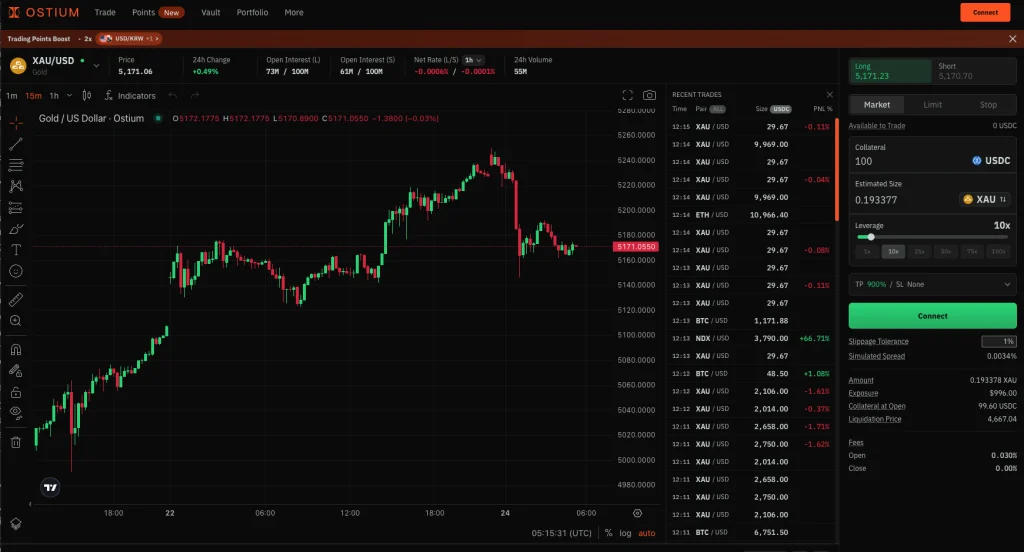
Ostium is building onchain perpetual futures for real-world assets, with 95% of open interest from non-crypto markets. Gold, silver, crude oil, S&P 500, forex — all from a self-custodial wallet on Arbitrum.
The protocol processed $34 billion+ in cumulative volume, captured 50%+ of onchain gold open interest during the rally, and raised $27.8 million from General Catalyst, Jump Crypto, Coinbase Ventures, and Wintermute. Ostium competes with brokers, not other DEXs, by quoting directly from offchain liquidity.
The target isn’t crypto traders who want RWA exposure. It’s the $10 trillion monthly CFD broker market that’s ripe for disruption by transparent, self-custodial infrastructure.
7. trade.xyz: 24/7 Stock and Commodity Perps on Hyperliquid
- Category: Perp DEX
- Chain: HyperEVM
- Trading volume: $58 billion
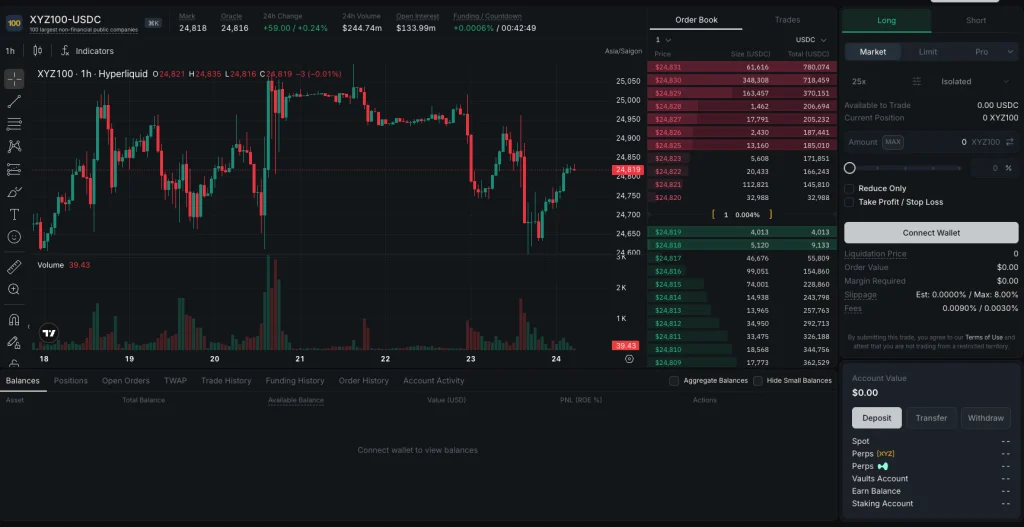
trade.xyz is a HIP-3 DEX on Hyperliquid offering perps on equities, indices, commodities, and forex. No KYC, non-custodial, 24/7 access. Pyth oracles during market hours, EMA-based pricing after close. Open interest: ~$740 million per DefiLlama. XYZ100-USDC is the trading pair reflecting the top 100 non-financial public companies.
While Ostium takes a pool-based approach on Arbitrum, trade.xyz leverages Hyperliquid’s deep orderbook, a different architectural bet with the same thesis: onchain access to everything. Regulatory risk from the CLARITY Act is the key variable.
trade.xyz is the first perp DEX to bring South Korean stock markets onchain.
8. Morpho: The Modular Lending Layer for Institutional DeFi
- Category: Lending and borrowing
- Chain: Ethereum, Base, Hyperliquid, Arbitrum, Katana, Plume, Monad, OP Mainnet and more.
- TVL: $8.8 billion
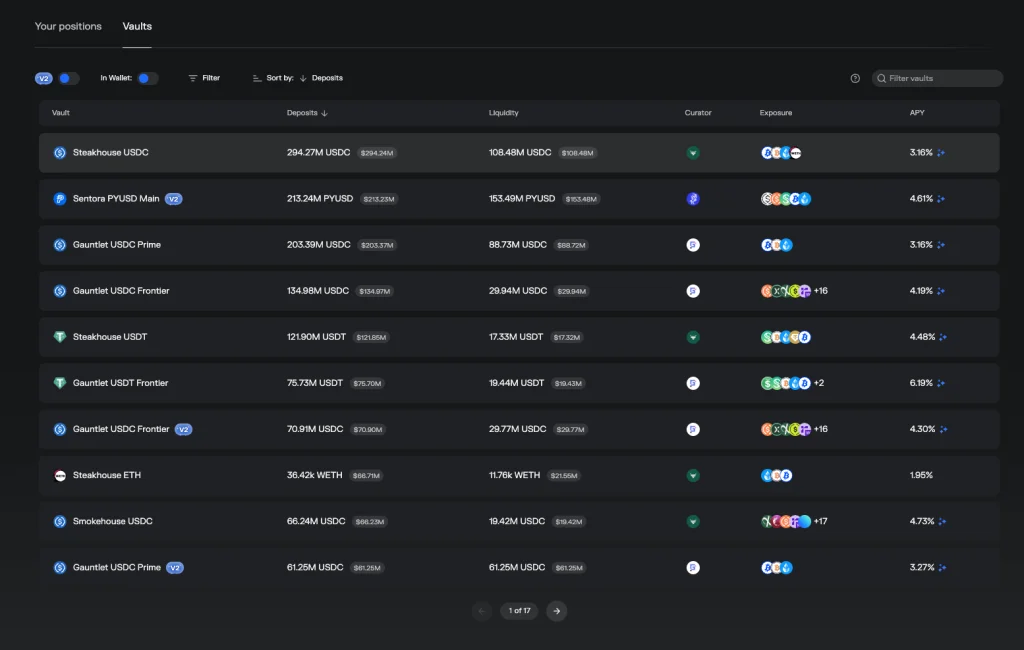
Morpho provides lending infrastructure on top of Aave and Compound with isolated, risk-segmented pools. Nearly $300 million in USDC is deposited by Steakhouse, and $213 million in PYUSD is deposited. Bitwise, Coinbase, and Crypto.com have deployed vaults on Morpho. Coinbase’s crypto-backed loans on top of Morpho hit $1B in originations in 8 months. The use of AA_FalconXUSDC as collateral on Morpho is at an all-time high of $74.2M, up over 100% YTD.
In practice, Morpho isn’t building a DeFi bank or Neobank; it’s making DeFi vaults, onchain lending and borrowing accessible to the mass financial investors via institutions with customizability, non-custodiality, and control. a16z’s wealth management thesis puts it in the “programmable wealth” category: non-custodial vaults with auto-rebalancing for real-time yield optimization.
9. RAILGUN: Private DeFi That Actually Works
- Category: DeFi tool
- Chain: Ethereum, Arbitrum, Polygon, and BNB Chain
- TVL: $123.93 million
RAILGUN is the most credible privacy protocol in Ethereum DeFi, and Railgun Wallet is why it’s on this list. Unlike legacy privacy tools that only hide balances, Railgun Wallet lets private wallets interact directly with DeFi frontends — tested live on CowSwap — without unshielding funds.
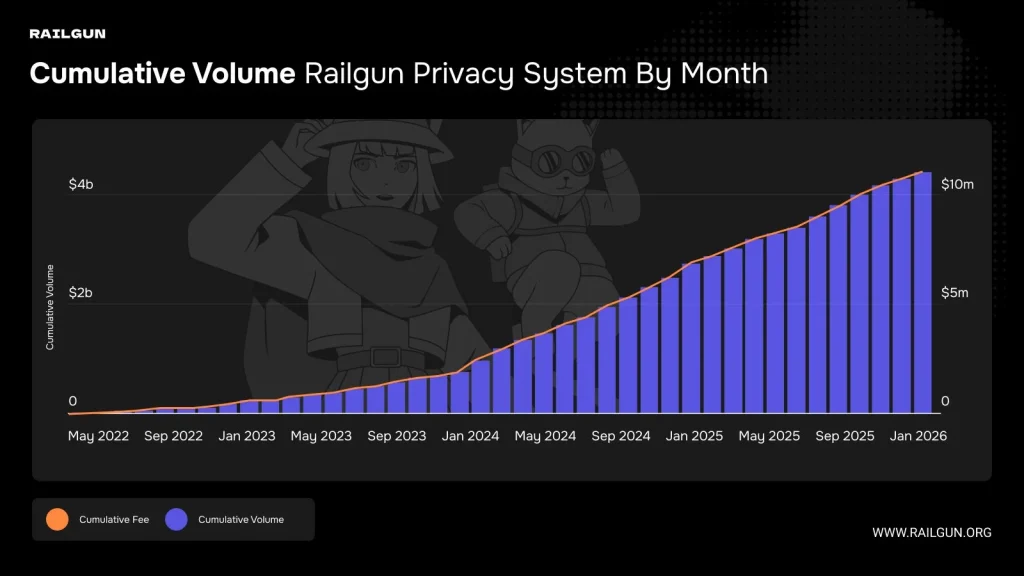
The protocol uses zero-knowledge proofs on Ethereum, Arbitrum, Polygon, and BNB Chain. Cumulative volume hit $4.5 billion in early 2026 (doubled YoY), with record daily shields of 326. The Ethereum Foundation staked 50,000 RAIL, and Vitalik Buterin praised its “Private Proofs of Innocence” — which blocked the zkLend attacker’s $9.5 million while maintaining privacy for legitimate users.
10. Payy: The Privacy-First Stablecoin Chain
- Category: Private crypto card and Ethereum L2
- Chain: Ethereum
- TVL: $784 million
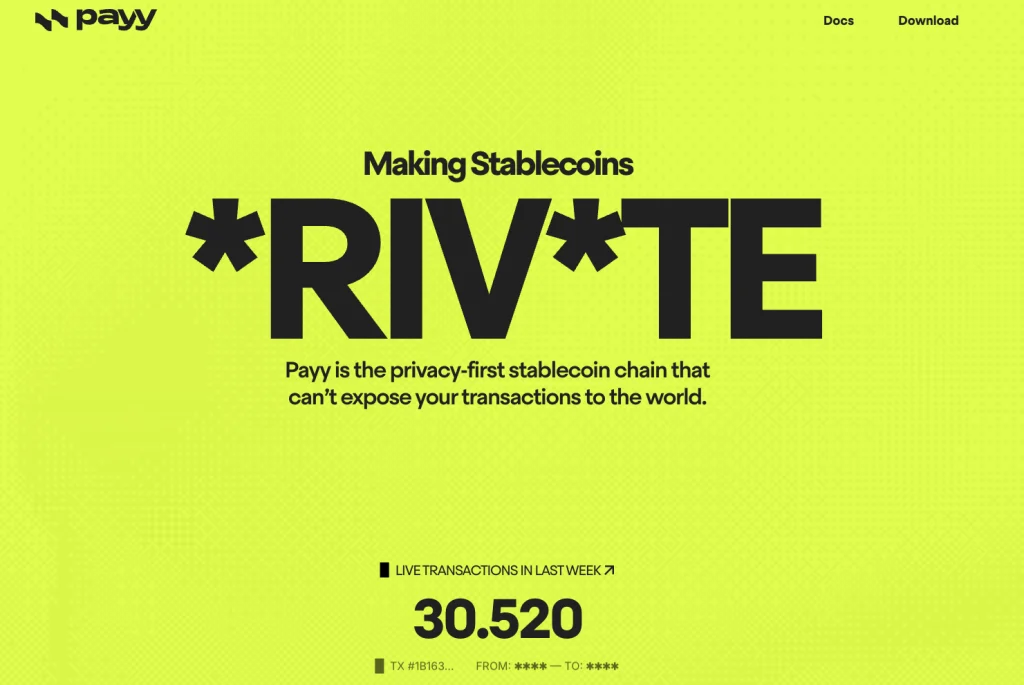
Payy started as a privacy-preserving crypto card. It currently introduced its Ethereum L2 on February 5, 2026, with a vision: every stablecoin transaction is a permanent data leak, and that’s the reason institutions won’t move real capital onchain. Their solution: automatic privacy for all ERC-20 transfers through private pools, no smart contract changes required.
The L2 works with any EVM wallet — add Payy as a custom chain in MetaMask, and every transfer routes through privacy pools by default. Built on custom ZK circuits in Halo2, the same framework Zcash uses. Payy’s wallet and crypto banking card attracted roughly 100,000 users since mid-2025, and undisclosed stablecoin issuers are confirmed as launch partners.
CEO Sid Gandhi’s framing is worth noting: banks, fintechs, and enterprises all say the same thing — they can’t move real capital onchain if financial data is exposed to the world. If RAILGUN solves privacy for DeFi power users, Payy is targeting the institutional and payments layer. Different users, same thesis.
11. ether.fi: The DeFi Neobank With 70,000 Active Cards
- Category: Crypto card and Neobank
- Chain: OP Mainnet, Ethereum
- TVL: $5.2 billion
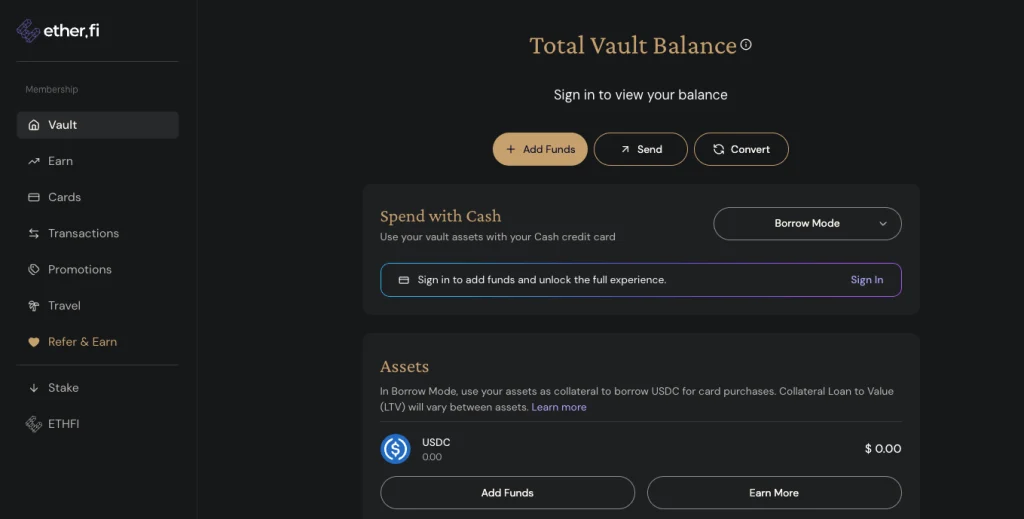
ether.fi started as a liquid restaking protocol with $5.2 billion in TVL. Now it’s a crypto neobank bridging DeFi yields with real-world spending. The Ether Cash card lets users borrow against staked assets and spend anywhere Visa is accepted, earning up to 3% cashback.
The traction is real: 70,000 active cards, 300,000 accounts, and the product accounts for nearly half of all crypto-native card transactions. EtherFi has migrated its infrastructure to Optimism to give Cash users deeper liquidity, a mature DeFi ecosystem, and native stablecoin support.
a16z’s “internet becomes the bank” thesis fits ether.fi perfectly. Pure DeFi is powerful but complex. Pure TradFi is familiar but extractive. ether.fi sits in the middle — DeFi yields under the hood, fintech UX on top.
Wrapping Up
The DeFi landscape in 2026 enters a new phase, leaner, smarter, and more focused on long-term value, privacy, and institutional-ready. The projects we’ve covered aren’t chasing short-term trends; they’re building real infrastructure, redefining token utility, and pushing the limits of capital efficiency.
As liquidity fragments and users get savvier, the protocols that survive will be those that solve real problems. These 11 standouts are doing just that, each in their own lane, but all pushing DeFi forward.
FAQ
What are the most innovative DeFi projects to watch in 2026?
The standouts include Paradex (zero-fee ZK perps), Boros (funding rate derivatives), World Markets (unified margin DEX), Morpho (modular lending), and Ostium (RWA perps). Each builds a genuinely new financial primitive rather than iterating on existing models.
Which new DeFi protocols are getting the most traction right now?
Paradex crossed $244 billion in cumulative volume. Ostium processed $34B+ in RWA perps. Variational hit $100 billion lifetime volume. ether.fi has 70,000 active Visa cards. Growth is driven by real usage and distinct architectural advantages.
Is DeFi still worth it in 2026?
DeFi in 2026 is fundamentally different from the speculative yield farming era. Protocols generate real revenue from trading fees, lending spreads, and funding rates. Smart contract risk, regulation, and volatility remain real, but the infrastructure is materially more sophisticated.
What DeFi projects do institutions actually use?
Morpho (Bitwise, Coinbase, Crypto.com vaults), ether.fi (institutional staking fund), and Payy (privacy L2 targeting banks and fintechs). Institutional DeFi adoption is driven by compliance-ready protocols with predictable, risk-segmented exposure.
How do real yield DeFi projects work?
Real yield comes from actual economic activity — trading fees, lending interest, funding rates — not token emissions. Paradex earns from retail price improvement, Morpho from lending spreads, Boros from funding rate markets. The distinction: sustainable revenue vs. subsidized rewards.
Disclaimer: This article serves informational purposes only and does not constitute financial advice. Conduct your own research before making investment decisions.
Follow Pink Brains on X for more DeFi updates!

.png)
%201.svg)
%201%201.png)